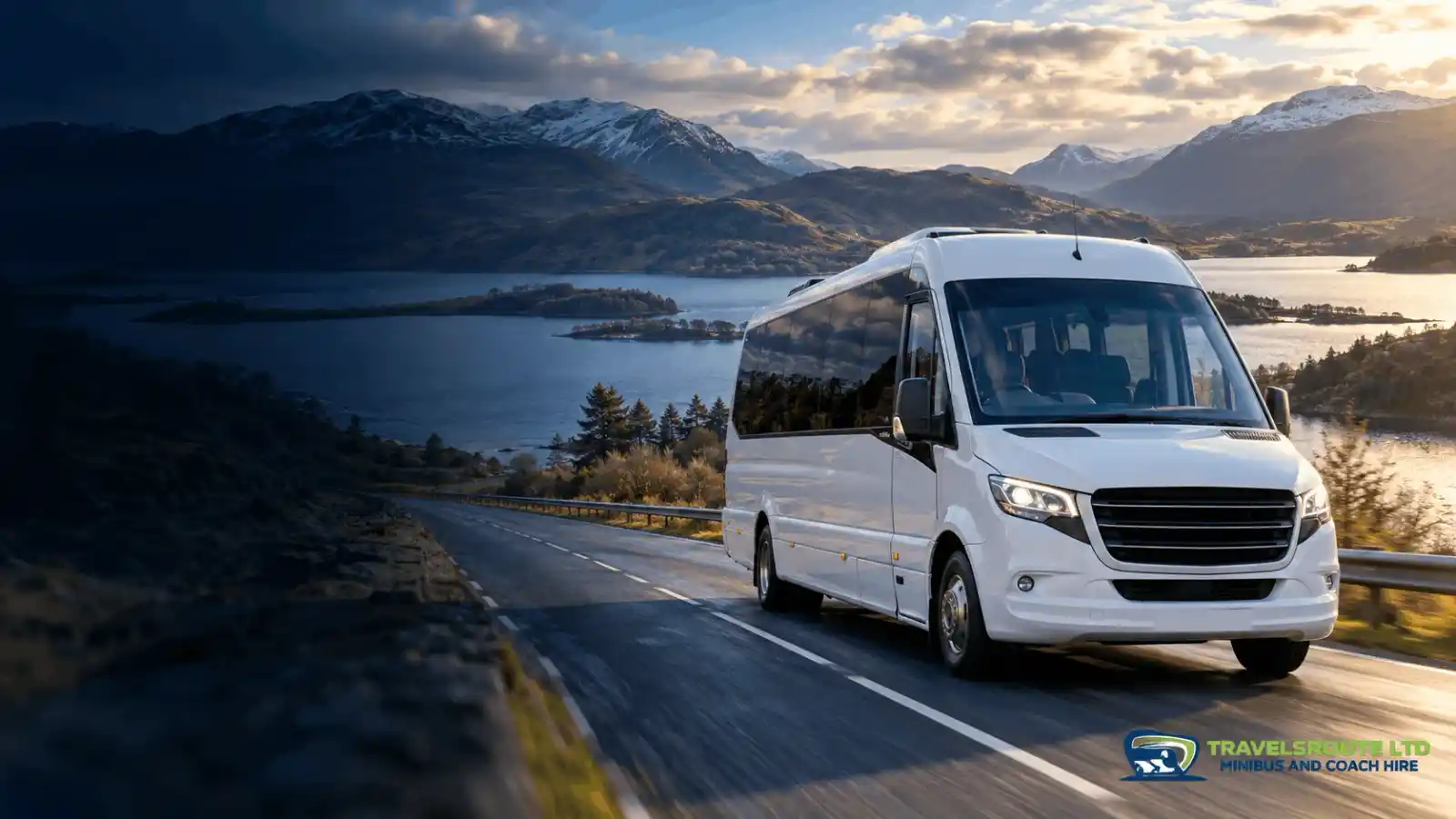
Glens, islands and the far north

Why does touring the Scottish Highlands need a different kind of plan?

The Highlands are not one destination but a huge region of mountains, sea lochs and islands, and most group trips here last several days rather than one.

North and west of the Highland Boundary Fault, towns thin out quickly. Fort William, Oban, Ullapool, Portree and Thurso are the main centres, and between them there can be an hour or more of road with nothing but hills, lochs and the odd village shop. That changes what a group needs from its transport.

A Highland tour is usually a chain of overnight stops: a night in Glencoe, two on Skye, one in Torridon or Ullapool, and so on. The same vehicle and driver stay with the group throughout, carrying the luggage from hotel to hotel and adjusting each day to the weather and the light.

The roads are the other difference. The A82 and A87 are main routes, but much of the west and north is single-track road with passing places. A smaller vehicle with a driver who uses passing places properly gets through calmly; a large coach can struggle, and some roads are signed as unsuitable for big vehicles.

That is why most groups book a minibus with a driver here rather than a full coach. For an overview of how a driven hire works, see minibus hire with a driver.

Row of white minibuses parked in front of mountains, ready for a Scottish Highlands tour

Which Highland routes do touring groups usually combine?

Three classic stretches that most multi-day Highland itineraries are built from.

Loch Lomond, Rannoch Moor and Glencoe

The A82 leaves Glasgow along the west shore of Loch Lomond, climbs through Crianlarich and Tyndrum, and crosses the open bog of Rannoch Moor before dropping into Glencoe beneath Buachaille Etive Mòr and the Three Sisters. It is about two hours from Glasgow to the glen without stops, and almost nobody does it without stops. Fort William, below Ben Nevis, is about 30 minutes further. From there the Road to the Isles runs west past Glenfinnan to Mallaig, where ferries cross to Skye.

The road to Skye

There are two ways onto Skye. The A87 runs west from the Great Glen past Eilean Donan Castle to Kyle of Lochalsh and the Skye Bridge. The other is the ferry from Mallaig to Armadale in Sleat, a short crossing that has to be booked for vehicles in summer. Many groups go out one way and back the other. On the island, Portree is the main base, about 50 minutes from the bridge, and the Trotternish loop past the Old Man of Storr and the Quiraing makes a full day.

The North Coast 500

This circular route of roughly 500 miles starts and ends in Inverness, running up the west coast through Applecross, Torridon and Ullapool, along the north coast to Durness and John o' Groats, and back down the east. Most groups take five to seven days. The west and north sections are largely single-track, with long gaps between villages. It is a route for a minibus, not a full-size coach, and it rewards a slow pace.

Where can a minibus meet a group at Highland stations, piers and trailheads?

Common meeting points on a Highland tour. Send us the exact place and we will confirm where the vehicle can stop.

Highland groups rarely start from one hotel door. They step off the sleeper at Fort William, walk into Gordon Square at the end of the West Highland Way, or come off a ferry at Armadale or Ullapool. Each has its own quirks for a vehicle.

Highland meeting points by type
PlaceTypeWhat to tell us
Fort William stationRail and sleeperTrains on the West Highland Line and the overnight sleeper from London. We meet at a point outside the station that a vehicle can reach.
Gordon Square, Fort WilliamWalk finishThe official end of the West Highland Way. The town centre is pedestrian, so we collect walkers from the nearest road access.
Mallaig and Armadale piersFerryFor the crossing to and from Skye. The vehicle joins the queue at the agreed time for the booked sailing.
Kyle of LochalshRail and bridgeEnd of the Kyle line from Inverness, just before the Skye Bridge. A useful pickup for groups arriving by train.
Portree, Isle of SkyeIsland baseNarrow streets around the harbour and square. Hotels outside the centre are easier for a minibus.
Ullapool ferry terminalFerrySailings to Stornoway on Lewis. Meet points on the shore road near the terminal.
Oban station and ferry terminalRail and ferryGateway to Mull and the southern isles. The station and terminal sit side by side on the harbour.

Ferry timetables, booking rules and car park arrangements change. Check before you travel and we will plan around the latest details.

How long do the main Highland legs take by minibus, and what are the roads like?

Approximate driving times without stops. Real days are longer, because nobody drives through Glencoe without stopping.

Times on a map are misleading in the Highlands. A 40-mile stretch of single-track road can take as long as 80 miles of motorway, and summer brings campervans, cyclists and sheep. We plan each day around realistic times plus stops, and never more driving than the group will enjoy.

LegApproximate timeWhat the road is likeVehicle notes
Glasgow to Glencoe

About 2 hours

A82, winding along Loch Lomond, open over Rannoch Moor

Any size; coaches use the main lay-bys

Fort William to Mallaig

About 1 hour

A830 Road to the Isles, now two-lane most of the way

Glenfinnan parking fills early in summer

Fort William to the Skye Bridge

About 2 hours

A87 through Glen Shiel past Eilean Donan

Any size; plan a stop at the castle

Portree to the Quiraing and back

About 1 hour 30 minutes

Single-track loop with steep bends

Minibus only; very small car park

Inverness to Ullapool

About 1 hour 15 minutes

A835, good two-lane road

Any size

Ullapool to Durness

About 2 hours 30 minutes

Long single-track stretches through Assynt

Minibus; fill up with fuel first

Durness to John o' Groats

About 2 hours

Single-track in places along the north coast

Minibus; few services between villages

Glasgow to Oban

About 2 hours 30 minutes

A82 then A85 past Loch Awe

Any size; check the A83 if routing via Inveraray

Roads such as the A83 at the Rest and Be Thankful can close after heavy rain, with diversions. Check before you travel.

Which airport is best for flying into the Highlands as a group?

It depends on where the tour starts and finishes, not on the shortest flight.

For tours of the west coast, Glencoe and Skye, most groups fly into Glasgow Airport. It is the start of the A82, so the scenery begins within the hour, and Fort William is about two and a half hours away without stops, and the Glasgow minibus hire page covers pickups in the city itself.

For the North Coast 500 or the far north, Inverness Airport is far closer, about 20 minutes from the start of the route in Inverness. It has fewer flights, mostly within the UK, so international groups often connect through London or fly into Edinburgh.

Edinburgh Airport has the widest choice of international flights. It suits tours that head north through Perthshire and the Cairngorms on the A9, or groups that want a night in the capital first. Pitlochry is about an hour and a half away.

Which vehicle size suits a Highland tour on single-track roads?

The sizes we recommend for touring the Highlands, with the reasons.

Smaller is better on the narrowest roads. A 9 seater, 12 seat minibus or 16 seater handles Skye's single-track loops and the north coast with ease. A 33 seat coach suits larger groups on the main routes through Glencoe and to Fort William, but we plan around the roads it should avoid.

VehicleSeatsLuggageBest forGood to know
9 Seater Minibus9Cases for a small touring partyCouples sharing a tour, Photography groupsEasiest on Skye's narrowest roads and smallest car parks.
12 Seater Minibus12A week's cases with seats spareNorth Coast 500 tours, Walking clubsOur usual choice for the far north.
16 Seater Minibus16Cases and kit for a full groupGlencoe and Skye tours, Wedding partiesFine on most single-track roads with a careful driver.
24 Seater Minibus24Day bags, or cases with a light loadSociety trips, Highland games daysBest kept to the main routes and larger villages.
33 Seater Coach33Full hold under the floorLarger tour groups, School trips to Fort WilliamMain roads only; not for Applecross or the Quiraing.

When should a group start planning a summer Highlands tour?

An example timeline for 14 people on a six-night tour from Glasgow through Glencoe and Skye to Inverness in June.

  1. Six to nine months before

    Fix the route and the overnight stops, then book hotels with parking or a safe drop-off for a minibus. Tell us the dates so we can hold a vehicle and driver for the whole tour.

  2. When ferry bookings open

    If the route includes the Mallaig to Armadale crossing or a trip to Mull or Lewis, the vehicle needs a place on the sailing. Check when bookings open and we will plan the day around the booked times.

  3. Two months before

    Send the final headcount, flight times and a rough luggage list, including walking poles, golf bags or anything bulky. We confirm the vehicle size and the driver's overnight arrangements.

  4. Two weeks before

    Agree the daily plan: departure times, lunch stops, distillery or castle bookings and any walks. We mark the fuel stops on the quieter stretches.

  5. The day before

    We check the forecast and any road closures on the A82, A87 and A83, and agree any changes, such as swapping the Quiraing for Dunvegan if the cloud is low.

  6. Each morning on tour

    A short briefing with the group leader on the day's timings, the weather and where the next stop for coffee and toilets will be.

Which Highland events and trips bring groups to the region?

Dates move from year to year, so check the official dates before you book.

The Jacobite steam train between Fort William and Mallaig, which crosses the Glenfinnan Viaduct, runs through the summer season and is a favourite with groups. Some ride the train one way while the minibus meets them at the other end, which saves driving the same road twice.

Corporate retreats and team trips to Highland lodges also need careful planning, with guests arriving from several airports. See our corporate travel page for how we handle staggered arrivals.

Highland games

Gatherings run through the summer, from small village games to the Braemar Gathering in early September and the Cowal Gathering in Dunoon in late August. Parking is usually in fields, so we agree a drop-off and a clear collection time.

Weddings at castles and lochside estates

Remote venues from Argyll to Skye mean guests often stay miles apart. We run loops between hotels and the venue and a late return after the ceilidh.

Wedding transport

West Highland Way walkers

The walk runs about 96 miles from Milngavie, north of Glasgow, to Fort William. Groups need a drop at the start and a pickup at the finish, sometimes days apart, and support crews may want luggage moved along the route.

Ben Nevis and the Three Peaks

Ben Nevis is the Scottish leg of the national challenge. Our Three Peaks Challenge minibus page covers the overnight drives between mountains.

Sports team travel

Which Highland sights work well as stops for a group?

Well-known stops with space for a group to get out and look around. Car parks fill in summer, so we plan arrival times.

Distilleries are a highlight for many groups, from Oban in the town centre to Talisker at Carbost on Skye and Ben Nevis at Fort William. Tours usually need booking and some have limited sizes, so tell us which ones the group wants.

Glencoe Visitor Centre

Run by the National Trust for Scotland, telling the story of the glen and the massacre of 1692, with group parking.

Glenfinnan Viaduct and Monument

The curved railway viaduct and the monument at the head of Loch Shiel, about 30 minutes west of Fort William.

Eilean Donan Castle

The castle on its island at Dornie, on the A87, about 15 minutes before the Skye Bridge.

Dunvegan Castle

The seat of Clan MacLeod in the north-west of Skye, with gardens and boat trips to see seals.

Smoo Cave, Durness

A huge sea cave on the north coast and a natural stop on the North Coast 500.

On a Highland tour the best day is rarely the one with the most miles. It is the one where the group had time to stop when the light was right on Loch Linnhe, and still reached the hotel before dinner.

Which Scottish cities make a good start or finish for a Highlands trip?

Many Highland tours begin or end in these places. Each has its own page.

The gateway to the north

The end of the A9 and the start and finish of the North Coast 500. Our Inverness page covers the city, Loch Ness and Culloden.

Common pickups: Inverness.

The west side

The A82 starts in Glasgow, the usual base for Glencoe, Fort William and Skye tours, and for West Highland Way walkers heading to Milngavie.

Common pickups: Glasgow.

Through the middle

Tours north on the A9 pass through Perth and Highland Perthshire. Stirling sits on the edge of the Trossachs, with Loch Katrine and Callander close by.

Common pickups: Perth, Stirling.

The east

Edinburgh is a common first or last night. Aberdeen is the way into Royal Deeside and Braemar.

Common pickups: Edinburgh, Aberdeen.

Before you go

What should a group know about passing places, fuel and weather in the Highlands?

Passing places are for letting oncoming traffic pass and for letting faster traffic overtake. They are not for parking or photographs, however tempting the view. Our drivers pull in to let others by and wait at the right place, which keeps the road moving and the locals friendly.

Fuel is a real planning point. In Sutherland, Wester Ross and on parts of Skye, filling stations are far apart and some close early or on Sundays. We fill up whenever the chance comes, rather than when the gauge says so.

The weather changes fast. A clear morning in Glencoe can turn to low cloud and rain by lunchtime, and from late spring to early autumn the midges come out on still, damp evenings. Pack layers and repellent, and keep the plan flexible.

The Bealach na Bà, the high pass to Applecross, is signed as not advised for large vehicles. In a smaller minibus and good weather it can be driven with care; with a bigger vehicle or poor conditions we take the longer coast road round by Shieldaig instead.

Winter tours are possible but shorter: daylight is limited, snow can close the high roads, and many smaller hotels shut for the season. For tours that continue south into England, see nationwide travel.

Plan your Highland tour with us

Send the dates, the number of travellers, your arrival and departure airports and the places you want to see. We will suggest a vehicle and a day-by-day route with realistic driving times.

Questions about touring the Highlands by minibus

Can a minibus drive the North Coast 500?

Yes. A 12 or 16 seat minibus suits the route well, including the single-track sections in the west and north. We avoid the Bealach na Bà in larger vehicles or bad weather and use the coast road instead.

How many days do we need for a Highlands tour?

Allow about a week for either the west coast and Skye or the North Coast 500. Trying to fit both into one week means long days on the road.

Can you include a ferry to Skye or the islands?

Yes. We plan around the Mallaig to Armadale crossing, or sailings from Oban and Ullapool. Vehicle space on busy summer sailings needs booking, so check before you travel.

Does the same driver stay with us for the whole tour?

That is how we plan multi-day tours where possible. The driver's overnight stops are arranged along the route, and daily driving stays within the legal limits.

Can you collect West Highland Way walkers at Fort William?

Yes. We drop at Milngavie, collect from the nearest road access to Gordon Square at the finish, and can carry luggage for the group.

Which airport should we fly into for Glencoe and Skye?

Glasgow Airport is usually best for the west coast. For the far north and the North Coast 500, Inverness Airport is much closer. See Glasgow Airport transfers.

Can you stop at the Glenfinnan Viaduct for the steam train?

Yes. The car park is busy in summer, so we plan the arrival well ahead of the train's crossing time and agree a collection point.

Is a coach or a minibus better for the Highlands?

For most tours a minibus, because of the single-track roads and small car parks. A coach works for larger groups keeping to the main routes, such as Glasgow to Fort William. See coach hire with a driver.